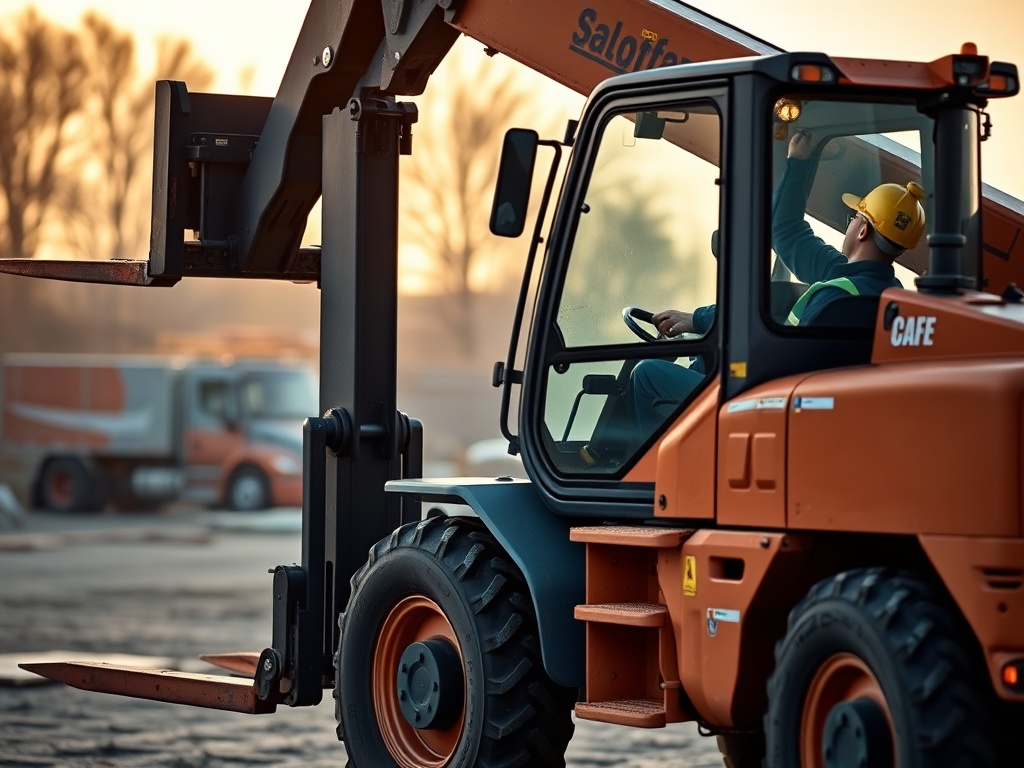
A telehandler is a rough-terrain lifting machine with a telescoping boom used to move, lift, and place materials on jobsites. It is versatile, but its capacity changes with boom angle, reach, attachment, ground condition, and load position, so operators must follow the load chart and site safety rules.
Key takeaway: A telehandler is not just a forklift with a longer arm. The farther the boom reaches, the more carefully the operator must manage stability, visibility, ground conditions, and attachment limits.
What a telehandler does well
Telehandlers are common on construction sites because they can unload trucks, move pallets, lift materials to elevated work areas, support framing operations, place roofing materials, and handle loads across uneven ground. Their reach makes them useful where a standard forklift cannot position material safely or efficiently.
OSHA’s powered industrial truck standards page is a useful starting point for understanding the regulatory framework around forklifts and related powered industrial trucks. OSHA powered industrial truck standards Telehandler requirements can also depend on the task, attachment, jurisdiction, and employer safety program.
The machine’s flexibility is the reason it needs careful planning. A telehandler used casually can create struck-by, tip-over, crushing, overhead, and load-drop hazards.
Common jobsite uses
Typical uses include moving palletized materials, staging masonry units, placing trusses or framing packages where permitted by the equipment and attachment, lifting roofing materials, supporting site logistics, and delivering supplies to upper floors or elevated decks. Some machines use forks, buckets, truss booms, or platforms, but attachment use must match manufacturer instructions and safety rules.
Telehandlers often support productivity, but they should be coordinated with delivery timing, laydown areas, and access routes. A site that tracks logistics well may also benefit from mobile field reporting because equipment use, deliveries, and access conflicts should be documented daily.
Using a telehandler as a substitute for a crane, aerial lift, or loader without proper planning is risky. The correct equipment depends on the load, reach, pick location, placement location, ground conditions, and required control.
Limits that operators and supervisors must respect
The load chart is central. Capacity changes as the boom extends or raises, and attachments affect the rated capacity. A load that is safe close to the machine may not be safe when extended forward. Ground slope, soft soil, tire condition, outriggers where equipped, wind, visibility, and sudden movements also affect stability.
The eCFR text for 29 CFR 1910.178 covers safety requirements for powered industrial trucks in general industry, including training and operation provisions. eCFR powered industrial trucks regulation Construction employers should verify all applicable OSHA rules, manufacturer instructions, and local requirements.
Supervisors should never ask an operator to exceed the chart, carry suspended loads without proper procedure, travel with elevated loads, lift people without approved equipment, or operate on unsuitable ground.
Safety practices before lifting
Before use, the operator should inspect the machine, review the load chart, confirm the attachment, check tires and fluids, test controls, look for leaks or damage, and confirm alarms or safety devices. The route should be checked for slopes, holes, overhead lines, pedestrians, other equipment, and ground bearing concerns.
Communication matters. Use spotters when visibility is limited, keep people clear of suspended or elevated loads, and establish exclusion zones where loads are being placed. Operators should keep loads low while traveling and avoid sudden starts, stops, or turns.
Telehandler planning table
| Planning factor | Why it matters | Field check |
|---|---|---|
| Load weight | Capacity depends on actual weight | Confirm before lifting |
| Reach and boom angle | Capacity changes as boom extends | Use the load chart |
| Attachment | Ratings can change with attachment | Verify manufacturer approval |
| Ground condition | Soft or sloped ground affects stability | Inspect route and landing area |
Telehandler use checklist
- Verify operator training and authorization.
- Match the machine and attachment to the load and task.
- Review the load chart before each non-routine lift.
- Inspect ground conditions, travel path, overhead hazards, and landing area.
- Keep pedestrians and workers clear of the operating zone.
- Document equipment issues and remove unsafe machines from service.
How supervisors should plan telehandler work
Telehandler planning starts before the machine arrives. Supervisors should know what materials will be lifted, where they will be unloaded, where they will be stored, and where they will be placed. The plan should account for travel paths, turning space, ground condition, overhead hazards, pedestrian routes, and communication with other trades.
Delivery coordination is especially important. If trucks arrive before the laydown area is ready, operators may be pressured to place materials in poor locations. If access routes are blocked, the machine may travel where it should not. Good logistics reduce the temptation to improvise with a heavy load in the air.
Attachments should be treated as part of the lift plan. Forks, buckets, truss booms, work platforms, and other attachments change what the machine can safely do. Operators and supervisors should verify that the attachment is approved for the machine and task, and that the load chart reflects the setup.
Weather and ground conditions should be reassessed during the day. Rain, thawing soil, traffic, excavation edges, and temporary ramps can change stability. A path that was acceptable in the morning may not be acceptable later.
A safer productivity mindset
Training should include both machine operation and site-specific expectations. An operator may understand the controls but still need orientation to pedestrian paths, delivery windows, exclusion zones, communication signals, and areas where ground conditions change during the project.
Document unusual lifts and near misses so the next crew can learn from them. A brief note about soft ground, blocked access, or a visibility problem can prevent the same issue from returning when the next delivery arrives.
The safest telehandler work is usually the most organized. Plan the pick, protect the route, keep people out of the line of fire, and stop when conditions change. Productivity improves when crews are not forced to solve access, staging, and communication problems during the lift itself.
Respect the reach before lifting
Telehandlers are valuable because they can solve many material-handling problems, but that versatility has limits. Plan each lift, follow the load chart, control the work zone, and use the right machine for the task.
This article is for informational and educational purposes only. It is not professional engineering, legal, code-compliance, financial, safety, or project management advice. Requirements vary by project, site condition, contract, and jurisdiction; consult qualified professionals and the authority having jurisdiction before making construction or maintenance decisions.
•
•